
Aviation Manager
Aviation Operations Assistant
Explore Career
A Design Thinking Facilitator is a professional who guides teams and organizations through the design thinking process—a human-centered, iterative approach to problem-solving that emphasizes empathy, ideation, prototyping, and testing. They help groups innovate by fostering creativity, collaboration, and user-focused solutions across industries like technology, healthcare, education, and business. This career falls under the Innovation and Strategy career cluster, highlighting leadership, creative problem-solving, and the growing importance of design-driven methodologies in modern workplaces.
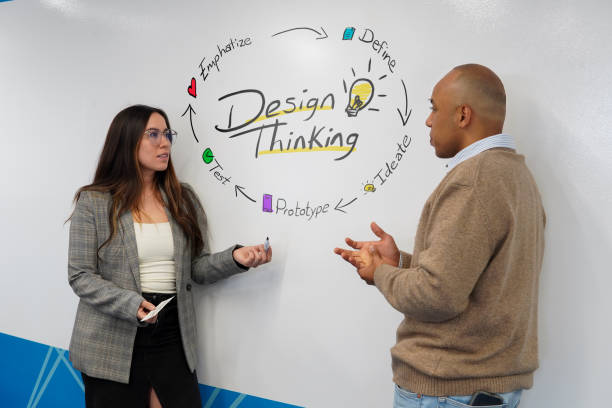
Design Thinking Facilitators lead workshops, brainstorming sessions, and projects to help teams address complex challenges by applying design thinking principles. Their work involves understanding user needs through empathy, encouraging divergent thinking for idea generation, and guiding the creation of prototypes to test solutions. They often collaborate with diverse stakeholders, including business leaders, designers, engineers, and end-users, working in corporate environments, consultancies, startups, or as independent practitioners. These facilitators are instrumental in driving innovation, transforming organizational cultures, and creating impactful solutions that prioritize human experiences in an increasingly complex world.
| Route | Steps |
| Route 1 (Design and Innovation Path) | 1. Bachelor’s degree in Design, Industrial Design, or Innovation Management (3-4 years) 2. Master’s in Design Thinking, Human-Centered Design, or Business Innovation (optional, 1-2 years) 3. Certificate or Short Course in Design Thinking Facilitation or UX Research (3-6 months) 4. Practical experience through workshops, internships, or innovation projects (1-2 years) |
| Route 2 (Business and Strategy Path) | 1. Bachelor’s degree in Business Administration, Management, or Marketing (3-4 years) 2. Master’s in Innovation Management or MBA with Design Thinking focus (optional, 1-2 years) 3. Certificate in Design Thinking or Creative Problem-Solving (3-6 months) 4. Gain experience via corporate innovation roles or consulting projects (1-2 years) |
| Route 3 (Psychology and Behavioral Science Path) | 1. Bachelor’s degree in Psychology, Behavioral Science, or Sociology (3-4 years) 2. Short course in Design Thinking or Human-Centered Design (3-6 months) 3. Learn facilitation through workshops or community projects (1-2 years) 4. Build experience by leading team-based innovation initiatives (1-2 years) |
| Route 4 (Self-Taught/Entrepreneurial Path) | 1. Basic education (10+2 or equivalent) with a passion for creativity and problem-solving 2. Self-study via online courses in Design Thinking and Facilitation (6-12 months) 3. Practice facilitation through personal or community projects (1-2 years) 4. Gain experience by offering workshops or consulting for startups (1-2 years) |
| Route 5 (International Path) | 1. Bachelor’s degree in relevant field (Design, Business, or Psychology) (3-4 years) 2. Master’s or Certification in Design Thinking or Innovation from an international university (1-2 years) 3. Short course in Advanced Facilitation or Strategic Innovation (3-6 months) 4. Work or internships with global innovation firms or consultancies (1-2 years) |
| Institute | Course/Program | Official Link |
| National Institute of Design (NID), Ahmedabad | Human-Centered Design and Innovation | https://www.nid.edu/ |
| Indian Institute of Technology (IIT), Bombay | Design Thinking and Innovation | https://www.iitb.ac.in/ |
| Srishti Manipal Institute of Art, Design and Technology, Bangalore | Design Thinking and Strategic Innovation | https://srishtimanipalinstitute.in/ |
| Indian School of Design and Innovation (ISDI), Mumbai | Design Thinking and Innovation | https://www.isdi.in/ |
| Symbiosis Institute of Design, Pune | Design and Innovation Management | https://www.sid.edu.in/ |
| Pearl Academy, Delhi | Design Thinking and Creative Strategy | https://pearlacademy.com/ |
| Amity University, Noida | Innovation and Design Thinking | https://www.amity.edu/ |
| Manipal Academy of Higher Education | Design and Innovation Studies | https://manipal.edu/ |
| Vellore Institute of Technology (VIT) | Design and Technology Innovation | https://vit.ac.in/ |
| IGNOU (Indira Gandhi National Open University) | Certificate in Innovation and Design | http://www.ignou.ac.in/ |
| Institution | Course | Country | Official Link |
| Stanford University (d.school) | Design Thinking and Innovation | USA | https://dschool.stanford.edu/ |
| Massachusetts Institute of Technology (MIT) | Design Thinking and Innovation Strategy | USA | https://www.mit.edu/ |
| University of California, Berkeley | Human-Centered Design and Innovation | USA | https://www.berkeley.edu/ |
| Royal College of Art | Service Design and Innovation | UK | https://www.rca.ac.uk/ |
| Aalto University | Design Thinking and Creative Business | Finland | https://www.aalto.fi/en |
| University College London (UCL) | Innovation and Design Strategy | UK | https://www.ucl.ac.uk/ |
| University of Toronto | Innovation and Design Thinking | Canada | https://www.utoronto.ca/ |
| Nanyang Technological University (NTU) | Design and Innovation Management | Singapore | https://www.ntu.edu.sg/ |
| Queensland University of Technology (QUT) | Creative Industries and Innovation | Australia | https://www.qut.edu.au/ |
| Parsons School of Design (The New School) | Strategic Design and Management | USA | https://www.newschool.edu/parsons/ |
India:
International:
Design Thinking Facilitator → Senior Design Thinking Facilitator → Innovation Program Lead → Director of Design Innovation → Chief Innovation Officer (CINO)
| India | International |
| Tata Elxsi (Innovation Division) | IDEO, USA |
| Infosys (Experience Design Team) | McKinsey & Company (Design Practice), USA |
| Wipro Digital | Accenture (Innovation Hub), Global |
| HCL Technologies (Innovation Lab) | Deloitte Digital, Global |
| Zensar Technologies | BCG Digital Ventures, USA |
| Mahindra Group (Innovation Team) | SAP (Design Thinking Division), Germany |
| Reliance Industries (Strategy Wing) | IBM Design, USA |
| Godrej & Boyce (Innovation Center) | Frog Design, USA |
| Aditya Birla Group (Innovation Hub) | Designit, Denmark |
| Flipkart (Product Innovation Team) | Fjord (Accenture Design), Global |
| Pros | Cons |
| High impact on driving innovation across diverse industries | Facilitating diverse teams can be challenging due to conflicting perspectives |
| Opportunity to work on meaningful, user-centered solutions | Requires constant adaptation to different industries, cultures, and challenges |
| Growing demand as organizations prioritize creative problem-solving | High pressure to deliver actionable results in short timeframes or workshops |
| Flexible career path with roles in corporate, consulting, or freelance settings | Emotional labor in managing group dynamics and fostering collaboration |
| Rewarding role in transforming organizational mindsets and cultures | Need to continuously upskill in facilitation techniques and industry trends |
(Figures are approximate and based on the latest available data and projections for 2026, subject to change. Indian figures reflect urban market trends and the growing innovation sector in major cities. International figures are based on US/UK markets with adjustments for demand, organizational size, and industry focus on design thinking.)
| Career Level | India (₹ per annum) | International (US$ per annum) |
| Senior Design Thinking Facilitator | 10,00,000 - 18,00,000 | $70,000 - $100,000 |
| Innovation Program Lead | 18,00,000 - 30,00,000 | $100,000 - $140,000 |
| Director of Design Innovation | 30,00,000 - 50,00,000 | $140,000 - $180,000 |
| Chief Innovation Officer (CINO) | 50,00,000 - 80,00,000 | $180,000 - $250,000 |
| Global Design Thinking Consultant | 40,00,000 - 70,00,000 | $160,000 - $220,000 |
A career as a Design Thinking Facilitator offers a remarkable opportunity to inspire innovation and transformation, guiding teams and organizations to solve complex challenges through empathy, creativity, and iterative problem-solving. These professionals are at the forefront of fostering user-centered approaches, reshaping how businesses, communities, and institutions tackle issues in a rapidly changing world. With opportunities spanning corporate innovation, consulting, and social impact, this field is ideal for those driven by a passion for creativity, collaboration, and strategic change. For individuals eager to lead others in designing a better future, this career presents a dynamic and profoundly impactful path with the potential to revolutionize industries and lives.

An experienced facilitator who leads complex workshops and projects, guiding cross-functional teams to solve high-stakes challenges with advanced...
0.0LPA

Oversees multiple design thinking initiatives within an organization, managing facilitators and aligning projects with strategic business goals to...
0.0LPA

Directs the overall design thinking strategy for a company or consultancy, embedding human-centered approaches into product development, services,...
0.0LPA
Take the next step and explore more about Design Thinking Facilitator.
Explore similar career paths that might interest you