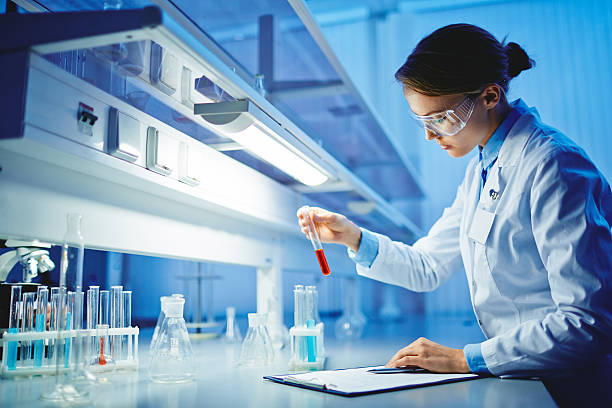
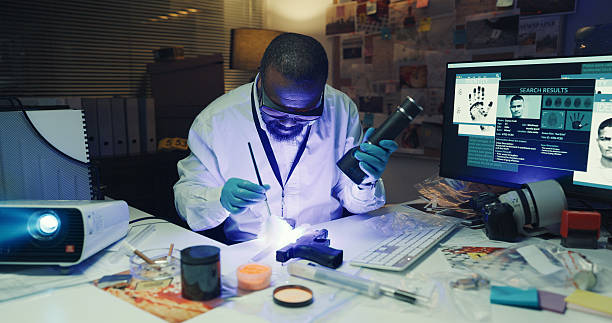
Forensic Scientists are analytically skilled and detail-oriented individuals tasked with collecting, preserving, and analyzing physical evidence such as DNA, fingerprints, blood, and trace materials to reconstruct crime scenes or identify suspects. Their role includes conducting laboratory tests, preparing detailed reports, and sometimes testifying in court as expert witnesses. They combine expertise in biology, chemistry, toxicology, and other sciences, working in diverse settings such as government labs, police departments, and private forensic firms. As key contributors to criminal justice, Forensic Scientists drive progress in a landscape increasingly focused on accuracy, digital forensics, and interdisciplinary collaboration.
- Evidence Collection and Preservation
- Collect physical evidence from crime scenes, ensuring proper handling to avoid contamination.
- Preserve evidence using standardized protocols for chain of custody and integrity.
- Laboratory Analysis
- Analyze biological samples (e.g., DNA, blood) and physical evidence (e.g., fingerprints, fibres) using scientific techniques.
- Perform chemical tests to identify substances like drugs or toxins in samples.
- Data Interpretation and Reporting
- Interpret analytical results to draw conclusions about the circumstances of a crime.
- Prepare detailed reports summarizing findings for law enforcement or legal proceedings.
- Collaboration with Law Enforcement
- Work with police, detectives, and legal teams to provide scientific insights into investigations.
- Assist in reconstructing crime scenes based on evidence analysis.
- Court Testimony
- Testify as an expert witness in court, explaining scientific findings to judges and juries.
- Defend the validity of methods and results under cross-examination.
- Specialized Testing
- Conduct specialized analyses such as toxicology for poison detection or ballistics for firearm identification.
- Use advanced tools like mass spectrometry or DNA sequencing for precise results.
- Teaching and Training
- Train law enforcement or junior scientists in evidence collection and forensic techniques.
- Educate legal professionals on the scientific basis of forensic evidence.
- Research and Development
- Develop new forensic techniques or improve existing methods for greater accuracy.
- Stay updated on emerging technologies like digital forensics or AI in evidence analysis.
| Route | Steps |
| Route 1 | 1. 10+2 in Science stream (Biology/Chemistry mandatory, Physics preferred) |
| 2. Bachelor’s in Forensic Science, Biology, or Chemistry (3-4 years) | |
| 3. Start as a Junior Forensic Technician in labs or law enforcement | |
| Route 2 | 1. 10+2 in Science stream (Biology/Chemistry mandatory, Physics preferred) |
| 2. Bachelor’s in Forensic Science, Biology, or Chemistry (3-4 years) | |
| 3. Master’s in Forensic Science or related field (2 years) | |
| 4. Work as a Forensic Scientist in labs or government agencies | |
| Route 3 | 1. 10+2 in Science stream (Biology/Chemistry mandatory, Physics preferred) |
| 2. Bachelor’s in Forensic Science, Biology, or Chemistry (3-4 years) | |
| 3. Master’s in Forensic Science or related field (2 years) | |
| 4. Ph.D. in Forensic Science or specialized area (3-5 years) | |
| 5. Pursue Roles as a Senior Forensic Scientist or Research Specialist | |
| Route 4 | 1. 10+2 in Science stream (Biology/Chemistry mandatory, Physics preferred) |
| 2. Bachelor’s in Forensic Science, Biology, or Chemistry (3-4 years) | |
| 3. Master’s in Forensic Science or related field (2 years) | |
| 4. Ph.D. in Forensic Science or specialized area (3-5 years) | |
| 5. Postdoctoral Research (1-3 years) | |
| 6. Serve as a Lead Researcher, Professor, or Forensic Consultant |
- Participation in forensic lab internships during or after academic programs for hands-on experience.
- Involvement in student-led mock crime scene investigations for practical exposure.
- Assisting senior Forensic Scientists in evidence analysis or casework for real-world insights.
- Observerships with police departments or government forensic labs for advanced learning and mentorship.
- Participation in forensic workshops or competitions for skill development and visibility.
- Training through collaborative projects like DNA profiling or toxicology studies for diverse exposure.
- Exposure to industry-standard practices like using spectrometry or fingerprint databases.
- Project-based learning focusing on varied areas like forensic biology, chemistry, or digital forensics.
- Community initiatives or legal aid projects to build practical experience in applied forensics.
- International forensic training programs or online courses for exposure to global crime-solving challenges.
- Bachelor of Science (B.Sc.) in Forensic Science, Biology, or Chemistry.
- Master of Science (M.Sc.) in Forensic Science or Criminology.
- Ph.D. in Forensic Science or related disciplines.
- Specialization in Forensic Biology (DNA Analysis).
- Certification in Forensic Toxicology.
- Training in Ballistics and Firearms Analysis.
- Workshops on Digital Forensics and Cybercrime.
- Short Courses in Fingerprint Analysis.
- Advanced Training in Forensic Anthropology.
- Courses in Crime Scene Investigation (CSI).
| Institute | Course/Program | Official Link |
| Lok Nayak Jayaprakash Narayan National Institute of Criminology & Forensic Science (LNJN NICFS), Delhi | M.Sc., Diploma in Forensic Science | https://nicfs.gov.in/ |
| Gujarat Forensic Sciences University (GFSU), Gandhinagar | B.Sc., M.Sc., Ph.D. in Forensic Science | https://www.gfsu.edu.in/ |
| University of Delhi, Delhi | B.Sc., M.Sc. in Forensic Science (via affiliated colleges) | https://www.du.ac.in/ |
| Banaras Hindu University (BHU), Varanasi | M.Sc. in Forensic Science | https://www.bhu.ac.in/ |
| Amity University, Noida | B.Sc., M.Sc. in Forensic Science | https://www.amity.edu/ |
| Osmania University, Hyderabad | M.Sc. in Forensic Science | https://www.osmania.ac.in/ |
| Dr. Harisingh Gour University, Sagar | B.Sc., M.Sc. in Forensic Science | https://www.dhsgsu.ac.in/ |
| Punjabi University, Patiala | B.Sc., M.Sc. in Forensic Science | https://www.punjabiuniversity.ac.in/ |
| University of Madras, Chennai | M.Sc. in Criminology and Forensic Science | https://www.unom.ac.in/ |
| Institute of Forensic Science, Mumbai | B.Sc., M.Sc. in Forensic Science | https://ifsc.edu.in/ |
| Institution | Course | Country | Official Link |
| University of Leicester, Leicester | B.Sc., M.Sc. in Forensic Science | UK | https://le.ac.uk/ |
| University of California, Davis | B.S., M.S. in Forensic Science | USA | https://www.ucdavis.edu/ |
| University of Strathclyde, Glasgow | B.Sc., M.Sc. in Forensic Science | UK | https://www.strath.ac.uk/ |
| George Washington University, Washington D.C. | B.S., M.S. in Forensic Science | USA | https://www.gwu.edu/ |
| University of Amsterdam, Amsterdam | M.Sc. in Forensic Science | Netherlands | https://www.uva.nl/en |
| University of Toronto, Toronto | B.Sc., M.Sc. in Forensic Science | Canada | https://www.utoronto.ca/ |
| National University of Singapore (NUS), Singapore | B.Sc., M.Sc. in Forensic Science (via related programs) | Singapore | https://www.nus.edu.sg/ |
| University of Technology Sydney (UTS), Sydney | B.Sc., M.Sc. in Forensic Science | Australia | https://www.uts.edu.au/ |
| King’s College London, London | M.Sc. in Forensic Science | UK | https://www.kcl.ac.uk/ |
| University of Lausanne, Lausanne | M.Sc., Ph.D. in Forensic Science | Switzerland | https://www.unil.ch/en/home.html |
India:
- NEET (National Eligibility cum Entrance Test): For admission to undergraduate programs in science-related fields in some institutes.
- GATE (Graduate Aptitude Test in Engineering): For postgraduate programs in forensic science or related fields at premier institutes.
- CSIR-UGC NET: For research fellowships and Ph.D. programs in forensic science.
- University-Specific Exams: Many institutes like GFSU or BHU conduct their own entrance tests for B.Sc., M.Sc., or Ph.D. programs.
- AFCAT (Air Force Common Admission Test): For forensic roles in defense services, if applicable.
International:
- SAT (Scholastic Assessment Test): Required for undergraduate admissions in the USA and some other countries.
- ACT (American College Testing): Alternative to SAT for undergraduate admissions in the USA.
- GRE (Graduate Record Examination): Required for postgraduate and Ph.D. programs in forensic science globally.
- TOEFL (Test of English as a Foreign Language): Minimum score of 80-100 required for non-native speakers applying to programs in English-speaking countries.
- IELTS (International English Language Testing System): Minimum score of 6.5-7.0 required for admission to universities in the UK, Australia, and other English-speaking regions.
Aspiring Forensic Scientist → Junior Forensic Technician → Forensic Scientist → Senior Forensic Scientist → Forensic Lab Supervisor → Research Director → Forensic Consultant → Professor → Policy Advisor → Global Forensic Expert
- Government forensic laboratories for criminal evidence analysis.
- Law enforcement agencies for crime scene investigation support.
- Private forensic firms for independent case analysis or consultation.
- Legal systems for expert testimony in court proceedings.
- Academic institutions for teaching and forensic research.
- Healthcare sector for forensic pathology or toxicology studies.
- Defence and military for forensic analysis in security cases.
- Cybersecurity firms for digital forensics and cybercrime investigations.
- International justice organizations for war crime or human rights investigations.
- Non-profit organizations for forensic support in humanitarian cases.
| India | International |
| Central Forensic Science Laboratory (CFSL) | Federal Bureau of Investigation (FBI), USA |
| State Forensic Science Laboratories (SFSL) | Interpol, Global |
| National Investigation Agency (NIA) | Scotland Yard, UK |
| Central Bureau of Investigation (CBI) | Drug Enforcement Administration (DEA), USA |
| Directorate of Forensic Science Services (DFSS) | Royal Canadian Mounted Police (RCMP), Canada |
| Indian Police Service (IPS) | European Union Agency for Law Enforcement (Europol), Europe |
| Ministry of Home Affairs | Australian Federal Police (AFP), Australia |
| Tata Institute of Social Sciences (TISS) | United Nations Office on Drugs and Crime (UNODC), Global |
| National Institute of Criminology & Forensic Science (NICFS) | National Institute of Standards and Technology (NIST), USA |
| Defense Research and Development Organisation (DRDO) | World Health Organization (WHO), Global |
| Pros | Cons |
| Opportunity to contribute to justice by solving crimes through science | High-pressure environment with tight deadlines for critical case results |
| Potential for societal impact through accurate evidence in legal proceedings | Emotionally taxing work due to exposure to violent or disturbing cases |
| Rewarding impact through advancements in forensic techniques and technology | Often requires long hours, including on-call duties for urgent investigations |
| Diverse career paths across government, private sector, and academia | Risk of burnout due to intense scrutiny and legal responsibility of findings |
| Strong potential for growth with the rise of digital forensics and cybercrime | Limited funding or resources in some regions for advanced forensic tools |
- Growing adoption of DNA profiling and genetic forensics for precise suspect identification.
- Rising demand for Forensic Scientists due to increasing cybercrime and digital evidence needs.
- Advancements in forensic toxicology for detecting new synthetic drugs.
- Heightened focus on forensic anthropology amid global human rights investigations.
- Expansion of interdisciplinary research combining forensics with AI and machine learning.
- Development of portable forensic tools for on-site crime scene analysis.
- Increased emphasis on specialized training for niche areas like digital forensics.
- Enhanced collaboration between Forensic Scientists and international justice bodies.
- Growing need for continuous skill development to master emerging forensic technologies.
- Focus on global ethical standards to address evidence integrity and privacy concerns.
| Career Level | India (₹ per annum) | International (USD per annum) |
| Junior Forensic Technician (Early Career) | 3,00,000 - 6,00,000 | 30,000 - 50,000 |
| Forensic Scientist (Mid-Career) | 6,00,000 - 12,00,000 | 50,000 - 80,000 |
| Senior Forensic Scientist (Established) | 12,00,000 - 20,00,000 | 80,000 - 120,000 |
| Forensic Lab Supervisor/Research Director | 20,00,000 - 35,00,000 | 120,000 - 160,000 |
| Professor/Global Forensic Expert | 35,00,000+ | 160,000+ |
Note: Salaries vary widely based on location, experience, sector (government vs. private), and specialization. International figures are approximate and depend on the country and funding. High-profile forensic or consultancy roles often yield significantly higher earnings based on impact and demand.
- DNA Analysis Software like CODIS for genetic profiling and matching.
- Fingerprint Analysis Tools like Automated Fingerprint Identification System (AFIS).
- Digital Forensics Software like EnCase for recovering data from electronic devices.
- Chemical Analysis Software for spectrometry and chromatography results.
- Crime Scene Reconstruction Tools like FARO 3D for mapping and visualization.
- Data Visualization Tools like Tableau for presenting forensic findings.
- Toxicology Analysis Platforms for identifying substances in biological samples.
- Online Forensic Databases like INTERPOL’s DNA Gateway for international collaboration.
- Ballistics Software like IBIS for firearm and bullet comparison.
- Collaboration Platforms like Slack for team communication in investigations.
- Indian Academy of Forensic Sciences (IAFS), India.
- American Academy of Forensic Sciences (AAFS), USA.
- International Association for Identification (IAI), Global.
- European Network of Forensic Science Institutes (ENFSI), Europe.
- Forensic Science Society of India (FSSI), India.
- Australian and New Zealand Forensic Science Society (ANZFSS), Australia/New Zealand.
- Canadian Society of Forensic Science (CSFS), Canada.
- International Society for Forensic Genetics (ISFG), Global.
- National Association of Medical Examiners (NAME), USA.
- World Police Summit Forensic Network, Global.
- Edmond Locard (Historical, France): Forensic Scientist since the early 1900s. Known as the "Sherlock Holmes of France" for establishing the exchange principle in forensics. His vision drives evidence theory. His impact shapes modern investigations.
- Bernard Spilsbury (Historical, UK): Forensic Scientist since the early 1900s. Known for pioneering forensic pathology in criminal trials. His creativity fosters legal evidence use. His legacy impacts courtroom science.
- Paul L. Kirk (Historical, USA): Forensic Scientist since the mid-1900s. Known as the "Father of Criminalistics" for advancing forensic techniques. His expertise drives microevidence analysis. His work influences forensic education.
- Alec Jeffreys (Contemporary, UK): Forensic Scientist since the 1980s. Known for developing DNA fingerprinting, revolutionizing criminal identification. His vision shapes genetic forensics. His impact drives global justice.
- Clyde Snow (Contemporary, USA): Forensic Scientist since the 1960s. Known for forensic anthropology work in identifying victims of mass atrocities. His leadership fosters human rights forensics. His work influences international investigations.
- Henry C. Lee (Contemporary, USA): Forensic Scientist since the 1970s. Known for contributions to high-profile cases and blood spatter analysis. His expertise drives crime scene reconstruction. His impact shapes forensic training.
- Patricia Cornwell (Contemporary, USA): Forensic Advocate since the 1990s. Known for popularizing forensic science through crime novels and research funding. Her creativity drives public awareness. Her contributions impact forensic interest.
- K. P. C. Gandhi (Contemporary, India): Forensic Scientist since the 1980s. Known for advancements in forensic toxicology and narco-analysis in India. His leadership shapes criminal investigations. His impact influences Indian forensic policy.
- B. B. Daulatabadkar (Historical, India): Forensic Scientist since the mid-1900s. Known for pioneering fingerprint analysis in Indian criminal justice. His expertise drives identification techniques. His work impacts national forensics.
- CleberBidegain Pereira (Contemporary, Brazil): Forensic Scientist since the 1990s. Known for forensic odontology and victim identification in mass disasters. His vision fosters disaster forensics. His contributions impact global humanitarian efforts.
- Build a strong foundation in biology and chemistry to handle diverse analytical challenges.
- Seek early exposure to lab or crime scene simulations to confirm interest in a forensic career.
- Prepare thoroughly for entrance exams like NEET or GRE to secure admission to top programs.
- Pursue training in specialties like DNA analysis or digital forensics for versatility.
- Stay updated on forensic trends by attending conferences and following research journals.
- Develop analytical skills through consistent participation in small-scale projects or internships.
- Engage in community or legal aid initiatives to build real-world experience.
- Join professional associations like AAFS or IAFS for networking and resources.
- Work on resilience and adaptability to manage high-pressure cases and emotional challenges.
- Explore international forensic opportunities for exposure to diverse investigative issues.
- Volunteer in forensic labs or police projects to understand industry dynamics.
- Cultivate precision skills to handle critical evidence and legal scrutiny.
- Attend continuing education programs to stay abreast of new forensic technologies.
- Build a network with investigators, legal experts, and forensic professionals for collaborative opportunities.
- Develop persistence to manage the uncertainty of case outcomes and legal proceedings.
- Balance scientific pursuits with ethical considerations to adapt to evolving justice standards.
A career as a Forensic Scientist offers a unique opportunity to contribute to justice, public safety, and truth by navigating complex evidential landscapes for diverse societal needs. From solving intricate crimes to advancing scientific methods in legal contexts, Forensic Scientists play a pivotal role in criminal justice and investigative ecosystems. This field combines analytical talent, technical skill, and a commitment to solving critical challenges, offering diverse paths in government, private sector, academia, and beyond. For those passionate about applying science to law, adapting to dynamic technological trends, and addressing global needs in an era of increasing crime complexity and digital evidence, a career as a Forensic Scientist provides an intellectually stimulating and professionally rewarding journey with the potential to make significant contributions to society by advancing the science and application of forensic knowledge worldwide.