We know more about the surface of the Moon and Mars than we do about the bottom of our own ocean.
Think about that for a second. The ocean covers over 70% of our planet, yet more than 80% of it is completely unmapped, unobserved, and unexplored. The deep sea is a massive, pitch-black frontier filled with underwater mountains taller than the Alps, deep trenches that could swallow Mount Everest whole, and bizarre, glowing creatures that look straight out of a sci-fi movie.
So, why haven't we just sent divers down to check it out? Because the deep ocean is actively trying to crush, freeze, and isolate anything that enters it.
To explore this extreme environment, marine scientists have teamed up with engineers to build the ultimate deep-sea explorers: Autonomous Underwater Vehicles (AUVs) and advanced ocean robotics. These aren't just remote-controlled toys; they are self-thinking, robotic submarines transforming us into an interstellar-style exploration force right here on Earth.
The Extreme Physics of the Deep
Before we talk about how these robots work, we need to look at what they are up against. If you dive down into the deep ocean—specifically the hadal zone (trenches deeper than 20,000 feet)—the conditions become staggeringly intense:
- The Crush Depth: At sea level, the air presses down on your body at roughly 14.7 pounds per square inch (psi). At the bottom of the Mariana Trench, the pressure multiplies to over 16,000 psi. That is equivalent to having an elephant standing on your thumb. It will instantly implode standard metal tubes or hollow structures.
- The Blackout: Sunlight completely disappears past 3,280 feet (1,000 meters). Below this "twilight zone," it is absolute, uninterrupted darkness.
- The Dead Zone for Radio: Radio waves, Wi-Fi, and GPS signals travel beautifully through space and air, but they can only penetrate a few inches into seawater before being completely absorbed.
Because of these rules of physics, humans can't easily go there, and we can't use regular remote controls from a boat. If a robot is down there, it has to navigate completely on its own.
Meet the Deep-Sea Robotic Fleet
Oceanographers use a mix of different robotic archetypes depending on what kind of mission they are running.
1. Remotely Operated Vehicles (ROVs)
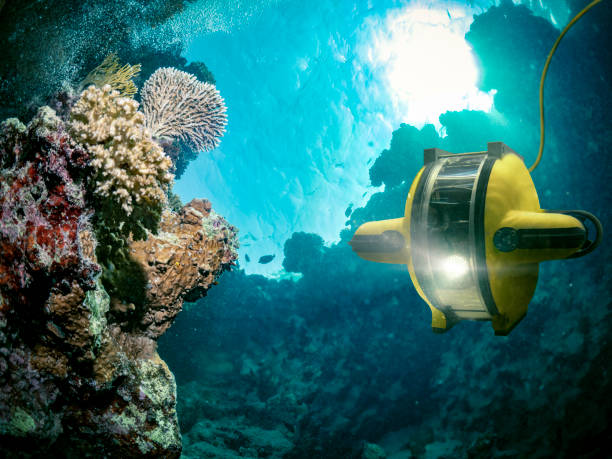
ROVs are tethered robots connected to a surface ship by a thick, heavy fiber-optic cable. The ship sends power and commands down the wire, and the ROV sends high-definition video and data back up. Because they have a constant power supply, ROVs can stay down for days, using heavy hydraulic robotic arms to scoop up samples or discover old shipwrecks.
2. Autonomous Underwater Vehicles (AUVs)
This is where the real magic happens. AUVs have no tether. Once they are dropped off the side of a research ship, they are entirely on their own. They follow a pre-programmed flight path, using onboard artificial intelligence to make decisions, map the seafloor, and navigate safely around underwater obstacles.
How an AUV Thinks and Navigates Without GPS
Because an AUV cannot connect to satellites or use GPS underwater, engineers have to get creative to keep the robot from getting lost in the dark.
1.Pre-Programming the Core Path:Mission Initialization.
Before deployment, engineers upload a digital flight plan to the AUV's computer, mapping out a grid pattern (like mowing a lawn) across the target survey area.
2.Dead Reckoning via DVL and IMU:Real-time Navigation.
To figure out where it is, the AUV uses an Inertial Measurement Unit (IMU) to track its acceleration and turning speed. It pairs this with a Doppler Velocity Log (DVL), which bounces acoustic sound pulses off the ocean floor to measure exactly how fast the robot is moving across the seabed.
3.Acoustic Mapping & Chemical Sensing:Data Collection.
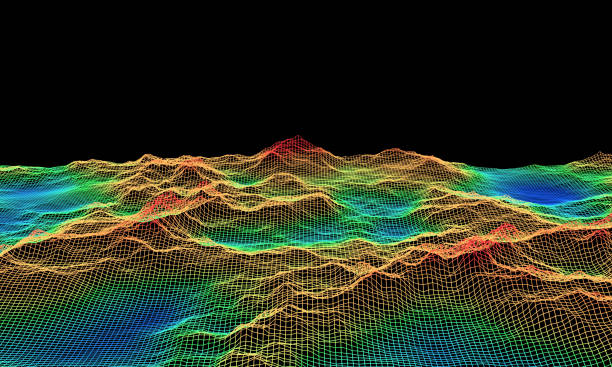
As the sub glides along, it fires out Side-Scan Sonar waves to create 3D topographic maps of the ocean floor. At the same time, specialized sensors sniff out chemical anomalies, tracking down toxic hydrothermal vents spitting out mineral-rich water at 700°F.
4.Surfacing and Data Uplink:Recovery Phase.
Once its battery runs low or the mission completes, the AUV drops internal weights to become buoyant. It floats back up to the surface, pops up an antenna, hooks back into a GPS satellite, and beams its location back to the research vessel for pickup.
Comparing the Specs: ROV vs. AUV
How do these two classes of underwater robots stack up against each other out in the field?
| Feature | Remotely Operated Vehicle (ROV) | Autonomous Underwater Vehicle (AUV) |
|---|---|---|
| Connection | Tethered (Thick fiber-optic umbilical cord) | Untethered (Completely free-swimming) |
| Control System | Human pilots sitting in a control room on a ship | Onboard AI and pre-programmed software scripts |
| Power Source | Fed continuously from the surface ship | Internal lithium-ion battery packs |
| Primary Mission | Precision tasks, heavy lifting, sampling, filming | Wide-area seafloor mapping, scanning, data gathering |
| Pros | Unlimited power; real-time video feedback | High mobility; doesn't require a massive stationary ship |
| Cons | Limited movement range due to cable drag | If the software glitches, the robot can be lost forever |
Career Spotlight: How to Build Underwater Robots
If you love robotics but are tired of standard rovers that just drive around on a flat gym floor, ocean engineering is a massive playing field. Building things for the ocean requires a unique mix of disciplines:
- Mechanical Engineering: Designing hulls out of syntactic foam (a special material filled with microscopic glass bubbles that won't crush under pressure) and sealing titanium pods to keep water out.
- Electrical & Acoustic Engineering: Figuring out how to use sound waves (sonar) instead of light waves to "see" and communicate through water.
- Computer Science & AI: Writing autonomous obstacle-avoidance code so the robot doesn't smash into an uncharted underwater cliff face when nobody is steering it.
Want to get started right now?
Look into MATE ROV competitions or SeaPerch. These are national student programs where high school teams design, build, and test their own underwater robots in local pools. It is the perfect hands-on way to find out if you have what it takes to explore Earth's final frontier.